A Green Valley surrounded by hills
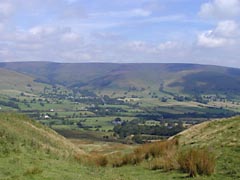 Edale from Mam Tor |
Overlooked by the Iron Age fort on Mam Tor, Edale Valley is the wide
expanse of green which lies just to the south of the great gritstone and peat
mass of Kinder Scout, which is usually accepted as the southern end of the
Pennines.
Probably not permanently settled in Saxon times, Edale (called 'Aidale' in
the Domesday Book) became part of the 'Royal Forest of the Peak' after the
Norman conquest. This 'Royal Forest' covered a large proportion of the modern
Peak District and in it farming and settlements were discouraged because they
got in the way of the hunting.
|
This meant that Edale developed slowly throughout mediaeval times. There
were herdsmans' shelters or 'booths' at what are now the hamlets of Upper
Booth, Barber Booth, Ollerbrook Booth and Nether Booth. The central 'booth' was
Grindsbrook Booth - now usually called Edale Village. Five Royal Farms were
established in the reign of King John but it was not until the Royal Forest
system effectively collapsed in Tudor times that proper settlements developed
in the valley. In Elizabethan times the valley was effectively a large cattle
ranch based around the five farms.
|
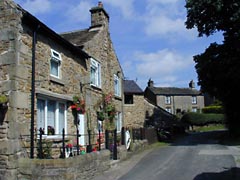 Modern Barber Booth |
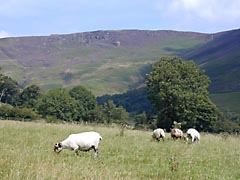 Sheep grazing near Edale Village |
By the eighteenth century the pastures were full of sheep rather than
cattle and the enclosure acts of the late 18th century resulted in the valley
becoming a patchwork quilt of small fields enclosed by stone walls built out of
the local gritstone. This had a dramatic effect on the look of the valley and
now the walls look as though they have been there for ever, but actually they
are mostly less than 200 years old.
|
In late Victorian times (1894) the railway arrived, driven through the
2-mile long Cowburn tunnel at the head of the vale. It linked Manchester to
Sheffield and rapid travel from Edale to either of these cities suddenly became
a possibility. It is no accident that most of the houses in Edale Village were
built shortly afterwards - for the first time, professional people were able to
live in the countryside and commute to work in the city.
|
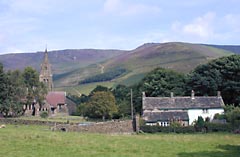 Edale Village |
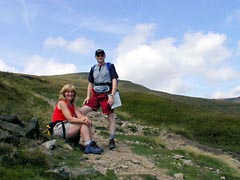 Modern Ramblers |
Commuters were not the only by-product of the railways. During the
period between the first and second world wars there was a strong movement for
people to get out of the grimy, smoky towns at the weekends and go walking or
'rambling' in the countryside. The Ramblers Association and the Youth Hostels
Association were products of this time, and each weekend the train would
disgorge thousands of ramblers at Edale station.
|
Initially, access to the moors was much restricted by landlords and
gamekeepers but this gradually crumbled under the relentless pressure of people
wanting to walk across the open spaces of the hills around Edale Valley, and
now the 'right to roam' is clearly established on Kinder and the surrounding
hills, under the stewardship of the National Trust and the Peak District
National Park.
|
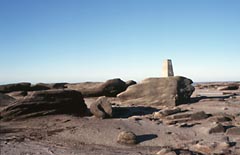 Kinder Low Trig Point |
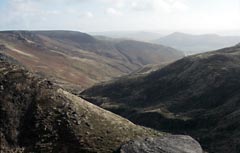 Looking down Grindsbrook to Edale |
This urge for the outdoors has continued to this day - though nowadays
most visitors come by car. Edale is a justly popular destination for folk who
want to walk, climb, mountain bike, hang-glide or just sit and admire the
magnificent scenery. Though the valley has changed over the centuries, it
remains unspoilt, and there are many places where even in the bustle of today
it is possible to escape from the crowds.
|
|
